
Inspection
Used boat inspection checklist: what to look for before you buy
A good used boat inspection takes about an hour and follows a set order: touch the engine, walk around the outside, the deck, the helm, the cabin, the bilge, the electrical system, the engine room, a cold start, and finally the paperwork. You're not trying to replace a marine surveyor. You're answering one question: is this boat worth paying a professional to look at?
If you find two or three serious problems, the answer is no, and you've saved the survey fee. If she passes, you walk into the survey with a list of things to have checked closely.
Ten tools to bring
- A bright flashlight, plus a headlamp so your hands are free
- A plastic-faced hammer (or a big screwdriver handle) for tapping
- An inspection mirror on a stick
- Clean white rags or paper towels for checking fluids
- A screwdriver set and a small adjustable wrench
- A compression gauge for gas engines and outboards
- A multimeter for checking battery voltage
- A jump pack, in case "it just needs a battery"
- Your phone, for photos of every problem, plate and serial number
- This checklist and a pen, and ideally a friend who's less in love with the boat than you are
Before you go, ask the seller not to start the engine before you arrive, and to have the title, registration, service receipts and any old surveys ready.
How serious is each problem?
Each item below carries a rough cost tag for a typical 20- to 40-foot boat. These are broad, judgment-based ranges, not quotes. Bigger and more complicated boats sit higher.
| Tag | Rough repair cost | What it means |
|---|---|---|
| $ | Under about $500 | Fix it yourself; a negotiating point |
| $$ | About $500 to $2,500 | Real money; price it in |
| $$$ | About $2,500 to $10,000 | Major job; get a quote before you offer |
| $$$$ | Over $10,000 | Often more than an old boat is worth; usually walk away unless the price reflects it |
The checklist, in the order that finds problems fastest
1. Touch the engine (2 minutes)
Before small talk, put your hand on the engine or the outboard cowling. If it's warm, ask why. A warm engine hides hard starting, smoke and noises. Come back for a cold start if you need to.
2. Walk around the outside (10 minutes)
- Hull sides: cracks, star-shaped or spider-web crazing (impact or flex), repairs that don't match in color. $ to $$$
- Rub rail and hull-to-deck joint: gaps, crushed sections, rail that's been re-fastened many times. $ to $$
- Waterline: a dirty stain line well above where she floats now can mean she sat low with water aboard. Ask about it.
- Transom: cracks around the outboard bolts or sterndrive opening. $$ to $$$$
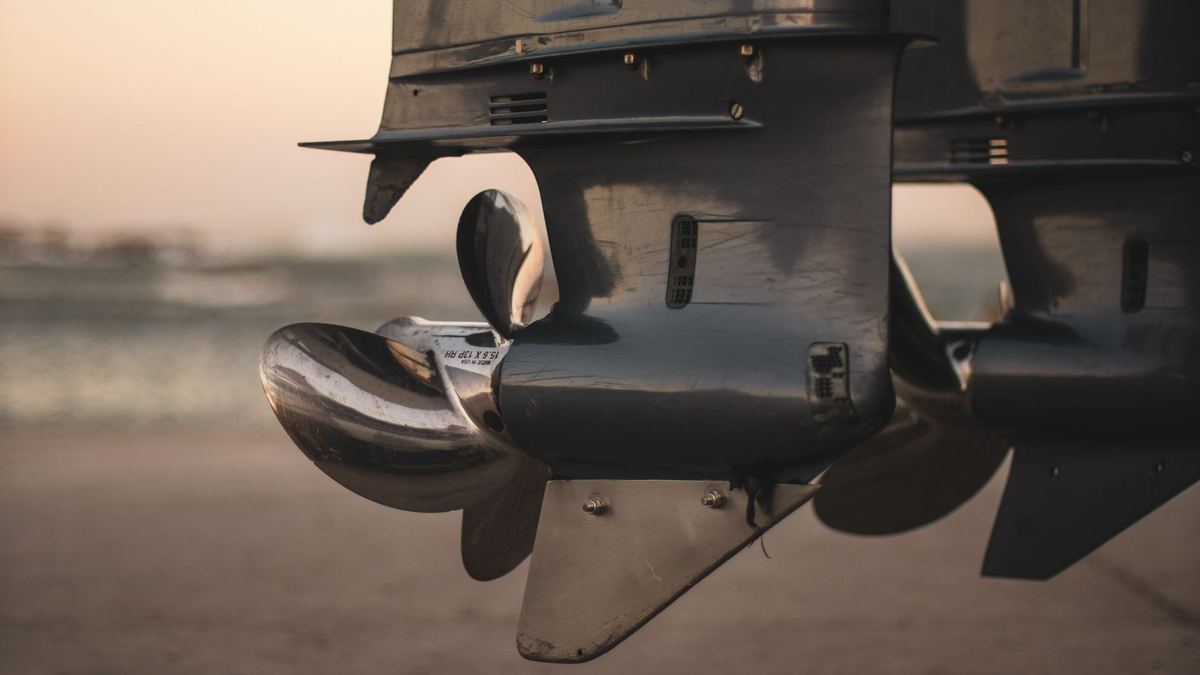
- Running gear (if out of the water): bent props, a worn cutless bearing (wiggle the shaft), missing anodes. $ to $$$
- Bottom: blisters, and whether they're in the paint, the gelcoat or the laminate. $ to $$$$
3. The deck (10 minutes)
- Walk every inch with your full weight, especially around fittings, the helm, the bow and hatches. Feel for flex or sponginess. $$ to $$$$
- Tap around stanchion bases, cleats, hatches and (on sailboats) chainplates and the mast step. A dull thud where you expect a crisp ring means wet or separated core. $$ to $$$$
- Push and pull on stanchions and rails. Loose ones leak. $ to $$
Wet core is one of the most expensive repairs on a fiberglass boat. Our guide to fiberglass boat problems explains how it happens and how to find it.
4. The helm and controls (5 minutes)
- Steering: lock to lock, smooth, no binding or excessive play; hydraulic steering shouldn't feel spongy. $ to $$
- Throttle and shift: smooth and positive. $
- Gauges and switches: dead gauges can mean bad wiring, or a reading nobody wanted you to see. $ to $$
5. The cabin, and your nose (10 minutes)
Sniff before you look.
- Mildew: leaks, poor ventilation, a boat that sat closed up. $ to $$$
- Gasoline: a fuel leak and a safety issue. Stop and find it. $$ to $$$$
- Sewage: rub a clean rag on a sanitation hose and smell the rag. If it stinks, the hoses need replacing. $ to $$
Then look at the headliner and cabinetry below every window and hatch for stains and swelling, the bottom edges of bulkheads for rot, and lift the floorboards to see the stringers and bilge. $ to $$$$
6. The bilge (5 minutes)
- What's in it? A little clean water can be normal. Oily water means an engine or transmission leak. Fuel means a fuel leak. $ to $$$
- Bilge pumps: lift each float switch by hand; the pump should run. $
- Hoses, clamps and seacocks: cracked hoses, rusted clamps and frozen seacocks below the waterline are a sinking risk. $ to $$
7. The electrical system (5 minutes)
- Batteries: date stamps, bulging cases, corroded terminals. A fully charged 12-volt lead-acid battery at rest reads about 12.6 volts or a little more. $ to $$
- Wiring: household wire, wire nuts, tape splices and missing fuses are signs of amateur work. $$ to $$$
- Shore power inlet: brown, melted plastic means overheating, a fire risk. $ to $$
8. The engine room (10 minutes)
- First impression: a clean, dry engine room with labeled filters is the best sign on any boat.
- Oil: wipe the dipstick on a white rag. Milky or frothy oil can mean water in the engine. $$$ to $$$$
- Coolant (engine cold only): oil floating in coolant is serious. $$$ to $$$$
- Rust and discoloration on exhaust elbows and risers; blistered paint near the exhaust can mean overheating. $$ to $$$$
- Belts, hoses and mounts: cracks, glazing, black belt dust, rusted or cracked mounts. $ to $$
- Fuel tanks: look at every visible part with the flashlight and mirror. $$ to $$$$
9. The cold start (5 minutes)
With permission, and with the blower running for at least four minutes on a gas inboard:
- Does she start easily, without long cranking?
- A puff of smoke on a cold diesel is normal. Persistent blue, black or white smoke isn't.
- Outboards should pee a steady stream from the telltale; inboards should spit water with the exhaust within seconds.
- Oil pressure should come up quickly; temperature should rise and settle.
On gas engines and outboards, ask to run a compression test: all cylinders should be within about 10 percent of each other, and a very low or zero cylinder means internal damage is likely.12 On diesels, ask to take an oil sample for analysis. For more on what engine numbers mean, see how many hours is a lot for a boat engine.
10. The paperwork (5 minutes)
- Title or documentation in the seller's name, matching the hull identification number (HIN) on the transom character for character
- Engine serial numbers matching the paperwork
- Service records that are dated, specific and from real shops
- Old surveys: read the findings and ask what was fixed
When to stop and go home
You don't have to finish the checklist once you have your answer. Thank the seller politely and leave if you find:
- A soft deck or floor over a large area, or a transom that flexes
- A strong gasoline smell with no obvious, simple cause
- Milky oil, or oil in the coolant
- A cylinder with very low or zero compression, and a price that doesn't reflect a rebuild
- A HIN that's been altered, or paperwork that doesn't match the boat
- A seller who won't let you look, start the engine or lift the floorboards
If the boat passes with only $ and $$ items, that's a good boat for her age. Write everything down: it becomes your list for the surveyor and the start of your negotiating notes.
Common questions
Can I inspect a used boat myself instead of hiring a surveyor?
You can filter boats yourself, and you should. But a walkthrough can't replace a professional survey on a boat with inboard engines, a cabin or a significant price. Surveyors use moisture meters, see the bottom at a haul-out, and know model-specific weak spots. See what a boat survey costs.
What's the single most important thing to check?
Structure. Soft decks, wet transoms, rotten stringers and leaking tanks are the most expensive problems and the hardest to see. Cosmetics are the cheapest to fix and the easiest to see, and buyers often get that backwards.
Should the engine be cold when I arrive?
Yes. Cold starts reveal hard starting, smoke and noises that disappear once the engine is warm. Ask the seller in advance not to run it before you get there.
Sources
HullVet guides are written by the HullVet team with AI help, from the research behind The Honest Boat Buyer's Kit, and facts are linked to their sources. They're general education, not a marine survey or legal, tax or financial advice. Rules and prices vary by state and change over time, so check what matters for your boat.